
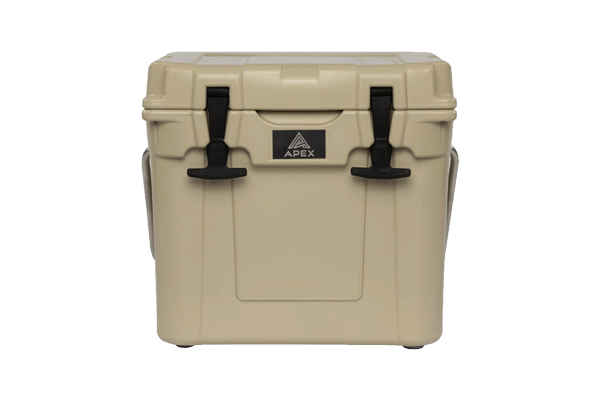
 A20 Cooler
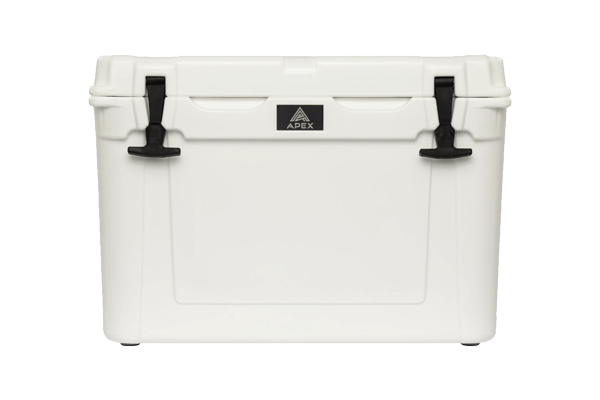 A45 Cooler
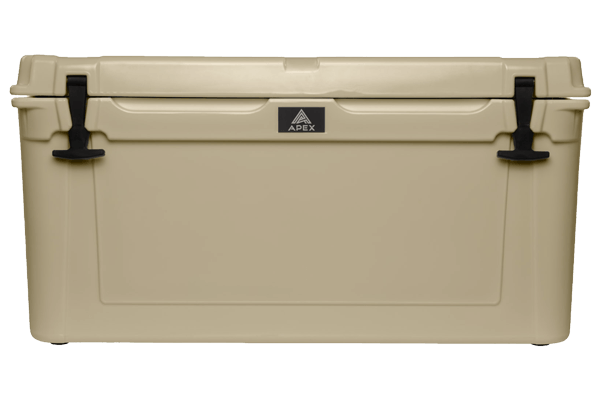 A75 Cooler
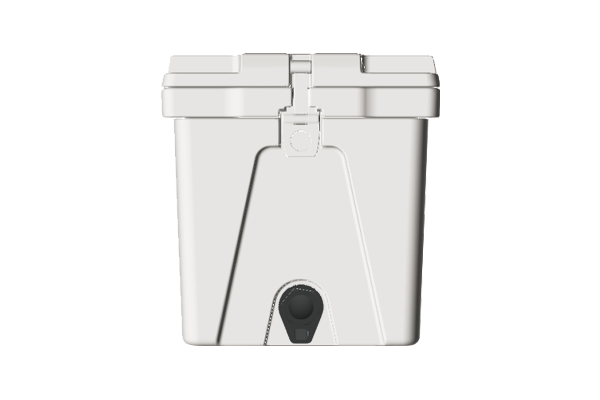 A3 Water Cooler

Apex A45 Cooler
The mid-size A45 hits the sweet spot—45 quarts of ice-cold storage with rugged side-carrying straps for two-person transport.
Nobody buys a cooler expecting to think about it again.
That's the whole promise. Ice goes in, ice stays cold, you get on with your day. It's a box. It has one job. How complicated could it be?
Then you spend a summer in a service truck.
First, let's kill the ice argument
Every cooler brand on earth sells you a number of days. Five days. Seven days. Ten days.
Here's what nobody selling a cooler wants to say out loud: those numbers are almost meaningless, and everybody in the industry knows it.
Ice retention depends on how much ice you started with. Whether the cooler sat in a sun-baked truck bed before you loaded it or in an air-conditioned shop. Whether anybody pre-chilled the cooler. Whether you bought bagged ice from a gas station that’s already begun to melt or the ice came direct from a machine — and yes, that genuinely matters. And more than anything else, how many times somebody opens the lid.
Look at how the most rigorous independent testers handle it. OutdoorGearLab runs coolers in a temperature-controlled room held between 74 and 75 degrees, loaded halfway with ice, with no food or cans inside to "muddy the readings," lid shut, for nine straight days.
That's a good test. It's repeatable, it's honest, and it tells you something real about insulation.
It also describes a scenario that has never once occurred on a job site.
Your crew isn't running a controlled experiment. They're running a cooler that's been in the sun since 6 AM, got opened forty times, has three lunch bags wedged in it, and got topped off with whatever ice was left at the gas station on the way out of town.
So we're not going to try to win you over with an ice number. Let's ask a better question.
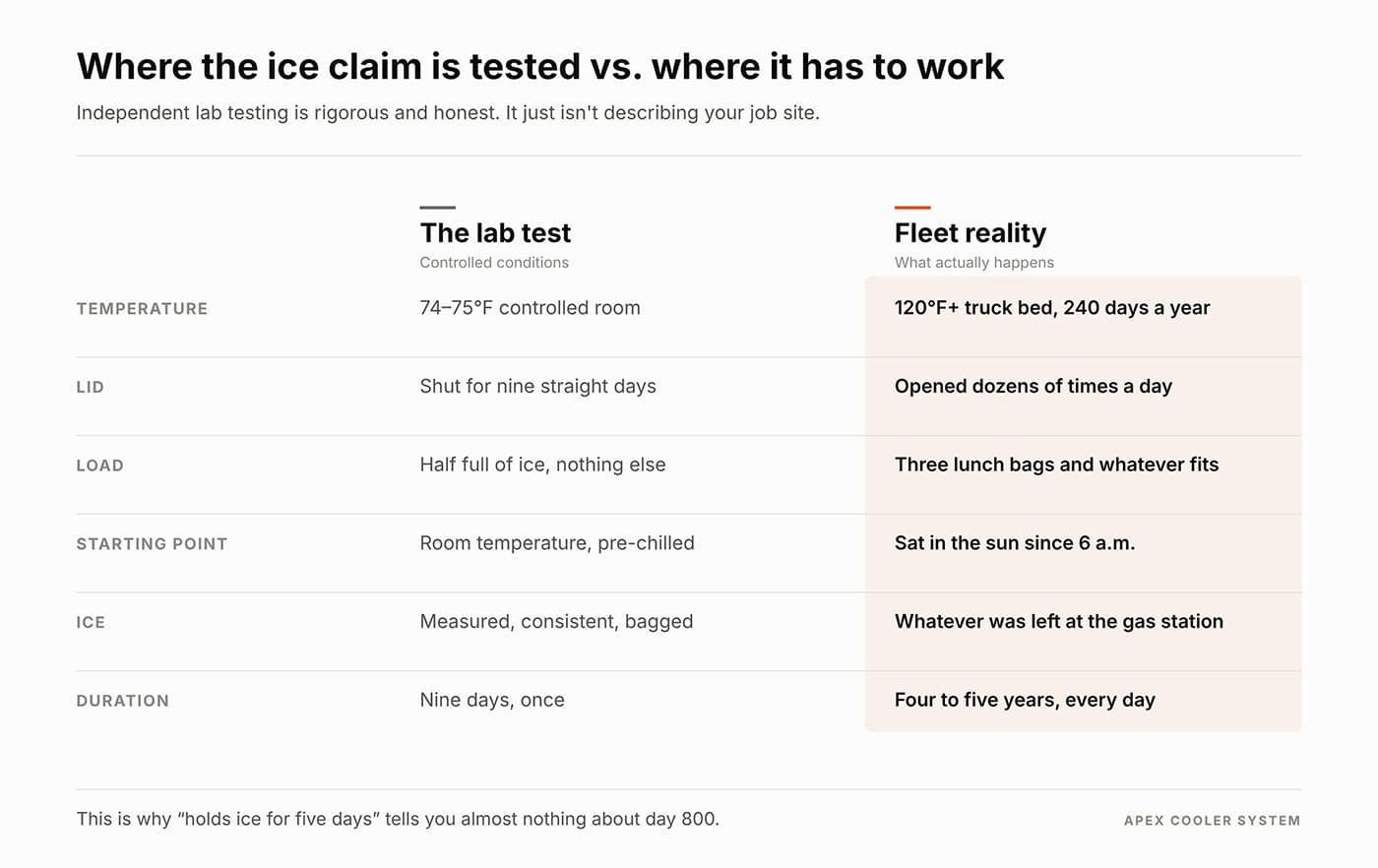
The question nobody asks: how many days does this cooler actually work?
Run the math on a field operator's cooler.
Five days a week, eight to ten hours a day. Back out holidays and PTO and call it 240 days in the field per year. A fleet truck runs four to five years before it cycles out. So across that vehicle's life, the cooler riding in it logs somewhere between 960 and 1,200 working days — roughly 8,600 to 10,800 hours in the sun, in the weather, on the road.
Now run the math on a consumer cooler.
A lake trip. A camping weekend. Two barbecues where it goes from the trunk to the kitchen. Maybe the beach. Be generous and say six to twelve outings a year. Over that same five-year window: 30 to 60 uses. Total.
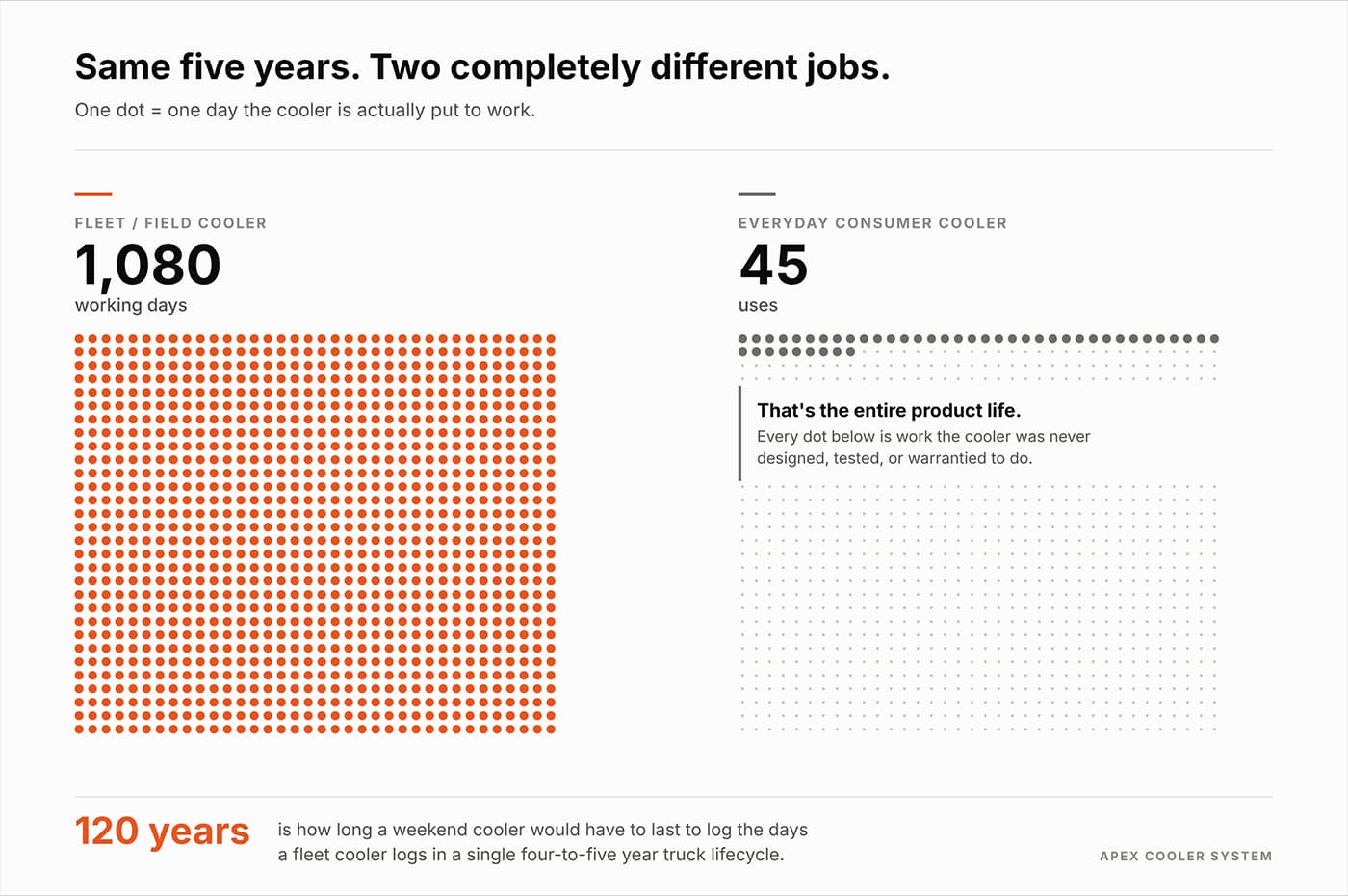
Put them side by side.
- Field cooler: about 1,080 days of hard use
- Weekend cooler: about 45 uses
For a weekend cooler to log the days a fleet cooler logs in one truck lifetime, its owner would have to keep it for 120 years.
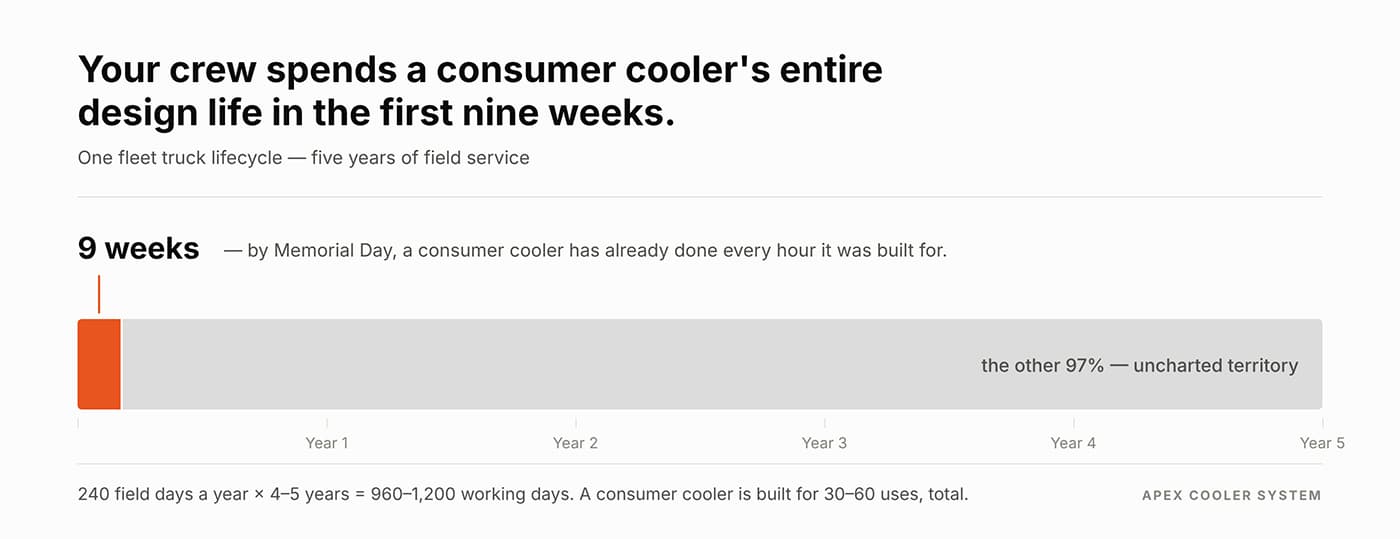
Flip it around and it gets worse. Your crew burns through a weekend warrior's entire five-year lifespan in about nine weeks. Not nine months. Nine weeks. By Memorial Day, that cooler has already done more work than most coolers were ever designed to do (spoiler alert: ours weren’t).
These aren't the same product used differently. They're different products entirely. One was engineered to sit in a garage for eleven months and perform for one weekend. The other has to show up every single morning for half a decade.
Guess which one is sitting in most work trucks right now.
What fleet reality actually tests
Insulation is the easy part. Fleet reality tests four things a consumer cooler was never asked about.
Heat that never lets up. On a day when the air only reaches 90, measured asphalt runs about 120 degrees and a sun-baked hood hits 130. Push the air temp to 100 and the blacktop climbs to 140, 150, even 160 degrees. A weekend cooler sees that maybe six times a year. A fleet cooler sits in it 240 days a year, for years — while UV quietly works on the polymer the entire time. Consumer coolers aren't tested against that because they never have to survive it.
The road. How many coolers have you seen on the shoulder, ejected off the back of a truck? You've seen at least one. That's not a cooler problem — that's an unsecured load problem, and it's a real one. The AAA Foundation found road debris was involved in more than 200,000 crashes over four years, causing roughly 39,000 injuries and 500 deaths — and about two-thirds of it came from items falling off vehicles due to unsecured loads and poor maintenance. A cooler in an open bed is cargo. Cargo either gets secured or it becomes somebody else's windshield.
The parking lot. How many times have you replaced a cooler because it was lost, stolen, or broken? If you manage 250 trucks and each one loses a cooler every other year, that's 125 coolers a year — plus the ordering, the receiving, the distributing, and the crew going without in the meantime. Nobody puts that on a P&L line called "cooler attrition." It just quietly leaks.
The lid. A crew of four opens that lid dozens of times a day. Hinges, latches, gaskets, and drain plugs are the parts that actually fail in the field, and they fail from cycles — not from years. A cooler that's been opened 20,000 times is a fundamentally different machine than one opened 1,500 times, no matter how thick the walls are.
And then there's the part that actually matters
Have you ever filled your bottle at 2:30 in the afternoon and the water came out at 80 degrees?
That's not just unpleasant. It's a safety problem with data behind it.
NIOSH recommends drinking water for workers in heat be kept below 59°F and placed near the work area. Eighty-degree water isn't marginally off — it's 21 degrees past the recommendation.
And warm water doesn't just taste bad. It changes how much people drink. In dehydration research, subjects offered water across a range of temperatures voluntarily drank the most at about 59°F. In simulated desert conditions, subjects given cold, flavored fluid rehydrated to 80.5% — versus 37% on the same fluid served warm. More than double.
That's the whole ballgame. NIOSH calls for a cup of water every 15 to 20 minutes in the heat. Nobody hits that on 80-degree water. They sip it, they make a face, and they wait for the next gas station.
How many times has the ice been gone and it's only lunchtime?
When it happens once, it's an annoyance. When it happens every afternoon in July across an entire fleet, it's a heat-illness exposure — in an industry where trade, transportation, utilities, and construction already lead the country in heat-related injury claims, and where roughly 40 workers a year die from occupational heat exposure.
So: does your cooler survive fleet reality?
Not "does it hold ice for five days in a lab." Does it hold up for 1,000 days in the field?
Does it stay on the truck at 70 miles an hour? Is it still there Monday morning? Do the latches still work in year four? Is the water actually cold at 2:30 in the afternoon in August — not on day one, but on day 800?
Consumer coolers aren't bad products. They're honest products, built exactly to the job they were designed for: infrequent use, moderate abuse, occasional sun. They were never tested against fleet duty cycles because fleet duty cycles were never the assignment.
Fleets need something else. Not a better box — a system. Something that mounts, locks, and stays with the vehicle. Something rated in working days instead of weekend days. Something built on the assumption that it lives outside, gets opened constantly, and has to be there when a crew member reaches for water at the end of a ten-hour day.
That's the category we build for at Apex. Not coolers that survive a good weekend — hydration systems that survive four years of Tuesdays.
And that’s exactly why we built Apex. Tough gear built for even tougher work.
Curious how your fleet's cooler attrition actually pencils out? Run the numbers on your own operation: trucks × replacement rate × unit cost, plus the hours your team spends sourcing and distributing them. Most fleet managers are surprised by what they find. We're happy to walk through it with you — apexcoolers.com | sales@apexcoolers.com
Essential Add-Ons:
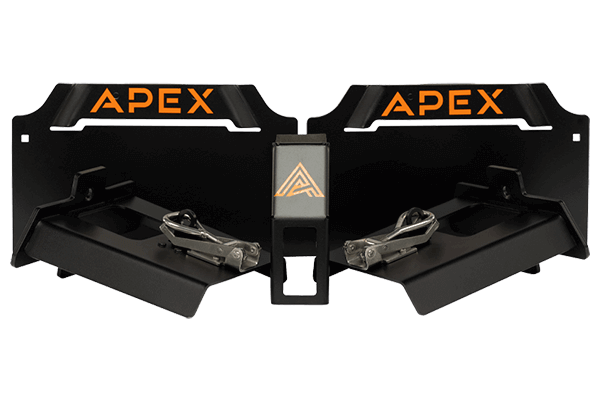
Bed Rack Gen 2
Bed Rack Gen 2 secures your A45 to any flat surface—pick-up beds, flatbeds, service bodies, utility trailers.
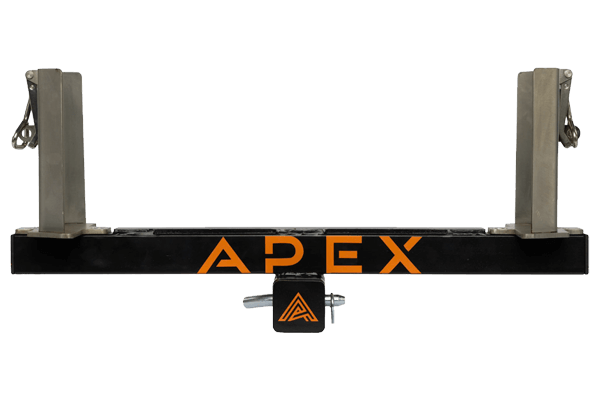
Hitch Rack
The Hitch Rack attaches to any standard 2" receiver hitch, keeping your A45 cooler locked down and accessible at the back of your vehicle.
Sources
OutdoorGearLab, cooler testing methodology View Source
AAA Foundation for Traffic Safety, The Prevalence of Motor Vehicle Crashes Involving Road Debris, United States, 2011–2014 View Source
NIOSH/CDC, Heat Stress Workplace Recommendations (water <15°C / 59°F) View Source
NIOSH Science Blog, Keeping Workers Hydrated and Cool (1 cup every 15–20 min) View Source
OSHA, Heat — Water. Rest. Shade. View Source
National Academies Press, Fluid Replacement and Heat Stress, "Palatability and Fluid Intake" (Boulze 1983; Hubbard 1984) View Source
USAFacts, How dangerous is extreme heat for America's workers? (BLS data) View Source
Surface temperature measurements under direct sunlight View Source